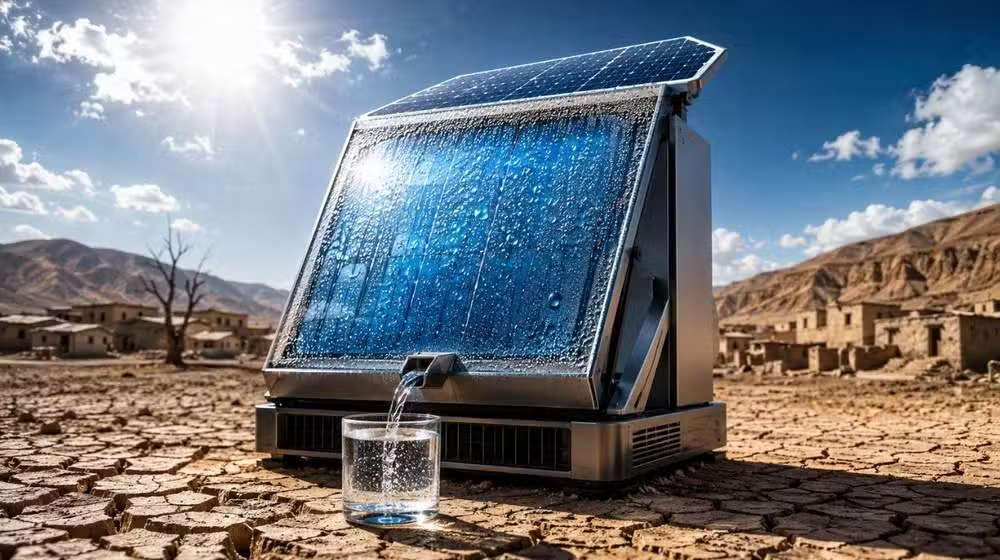
Researchers from Stanford University and Massachusetts Institute of Technology have developed an innovative solar-powered hydrogel capable of extracting moisture from the air and converting it into clean drinking water.
The breakthrough technology could provide a sustainable solution for communities living in dry and water-scarce regions where access to safe drinking water remains limited. Scientists believe the material may help address growing global water shortages caused by climate change and population growth.
According to recent estimates published by the World Health Organization and UNICEF, nearly 2.1 billion people worldwide still lacked access to safely managed drinking water in 2025. The new hydrogel technology is being viewed as a promising low-cost alternative for producing clean water in challenging environments.
The hydrogel works using a sponge-like material made from lithium chloride and polyacrylamide. Lithium chloride is known for its strong moisture-absorbing properties, while polyacrylamide is a commonly used polymer found in products such as diapers and water-absorbing materials.
Researchers explained that the hydrogel captures water vapor directly from the surrounding air, even in low-humidity environments such as deserts. Once the material absorbs moisture, sunlight naturally heats the hydrogel and causes the trapped water to evaporate.
The released vapor can then be condensed into liquid form, creating drinkable water without requiring electricity or complex infrastructure. This solar-driven process makes the system energy-efficient and potentially suitable for remote or off-grid communities.
Scientists involved in the project say one of the major improvements in the new hydrogel is its longer lifespan and increased durability compared to earlier atmospheric water harvesting materials. Previous systems often faced challenges related to material degradation and reduced efficiency over time.
The development reflects growing global interest in atmospheric water harvesting technologies, which aim to extract water directly from the air using advanced materials and renewable energy sources. Researchers worldwide are exploring such innovations as freshwater shortages continue to impact millions of people.
Experts believe technologies like this could eventually support disaster relief operations, military deployments, remote villages, and regions heavily affected by drought. Portable water-generation systems based on hydrogels may also reduce dependence on expensive water transportation and groundwater extraction.
While the technology is still under further research and optimization, scientists say the early results are highly encouraging. Future improvements may increase water production capacity and lower manufacturing costs, making the hydrogel more accessible for large-scale humanitarian use.
The breakthrough demonstrates how material science and renewable energy can work together to tackle one of the world’s most pressing environmental and public health challenges.