
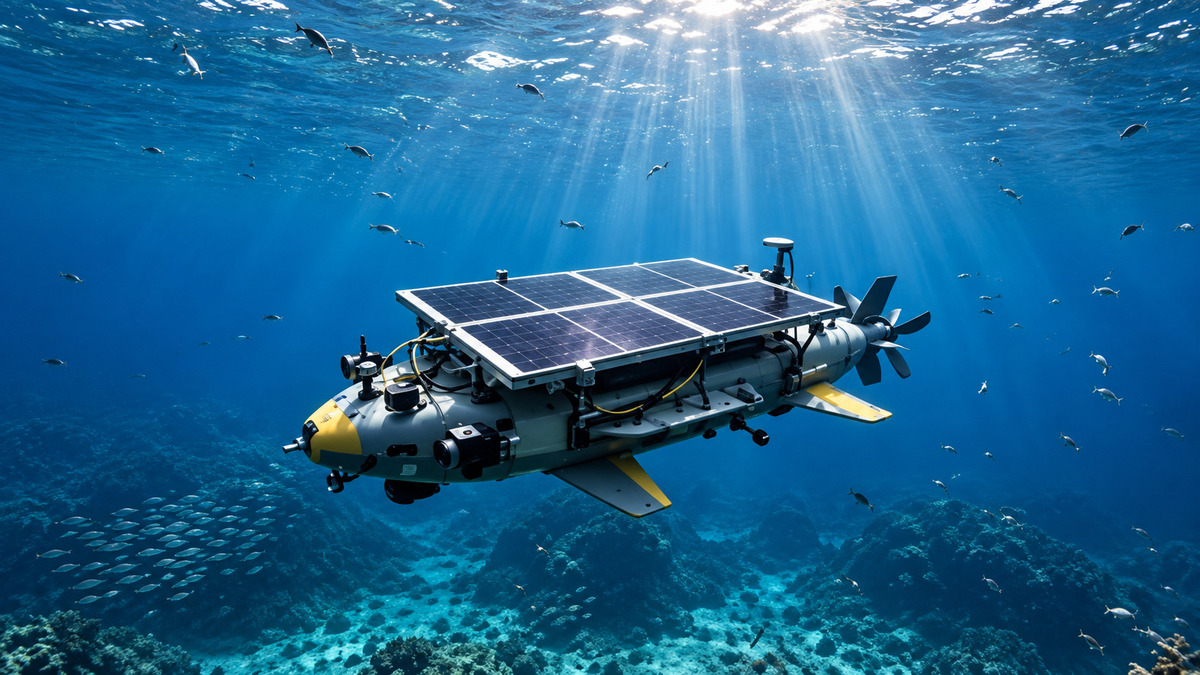
Researchers at Yunnan University have developed a new type of solar cell designed specifically to generate electricity in underwater environments, potentially opening another route for powering marine sensors and autonomous underwater equipment.
The research, led by Simin Ma, focuses on perovskite solar cells, a technology that has attracted significant scientific interest because of its ability to efficiently convert light into electricity while offering greater flexibility in how the material is engineered.
Solar power underwater presents a major technical challenge because water changes the amount and type of sunlight available to a solar panel. As light travels through water, many wavelengths are absorbed or weakened before reaching equipment positioned below the surface.
Conventional silicon solar panels are designed around the characteristics of sunlight available in normal outdoor environments. Their performance can therefore be affected when they are placed underwater, where the available light spectrum is significantly different.
Perovskite materials offer an important potential advantage in this environment. Researchers can chemically modify these materials to respond to particular wavelengths of light, allowing solar cells to be designed for conditions where conventional photovoltaic technology may be less effective.
This wavelength-tuning capability could make perovskite solar cells particularly useful for underwater applications. Rather than relying on the same portions of the light spectrum used by conventional solar panels, researchers can adjust the material’s properties to better match the light that remains available beneath the water.
The development could have practical implications for marine technology. Underwater sensors often need a reliable source of electricity to collect information about temperature, pressure, water quality, marine life and other environmental conditions.
Providing these systems with renewable power could potentially reduce their dependence on batteries. That could be particularly useful for equipment deployed in locations where regular maintenance or battery replacement is difficult and expensive.
Autonomous underwater vehicles and other robotic systems could also potentially benefit from improved underwater energy generation. Such equipment can spend extended periods below the surface collecting data or performing specialized tasks, making energy efficiency and reliable power sources important considerations.
However, underwater solar technology still faces several challenges before it can become widely practical. The amount of sunlight decreases with depth, and environmental factors such as water clarity, temperature and the surrounding conditions can influence how much usable light reaches a photovoltaic device.
The durability of perovskite solar cells will also be an important consideration. Technologies intended for long-term underwater deployment must be capable of operating reliably while exposed to water and other environmental stresses.
The Yunnan University research demonstrates how photovoltaic technology can be adapted for environments that differ substantially from conventional solar installations. Instead of treating underwater conditions simply as a limitation, researchers are exploring whether solar cells can be redesigned around the light spectrum that exists beneath the surface.
The approach could eventually contribute to a broader range of marine energy solutions. While the technology is still at the research and development stage, specialized solar cells could provide another option for powering low-energy underwater electronics.
As demand grows for continuous monitoring of oceans, rivers and other aquatic environments, reliable autonomous power sources are becoming increasingly important. Underwater solar cells could potentially play a role in supporting these systems without relying entirely on traditional batteries.
The research led by Simin Ma highlights the growing versatility of perovskite photovoltaic technology. Further development and testing will determine whether these underwater solar cells can eventually move beyond laboratory research and into practical marine applications.