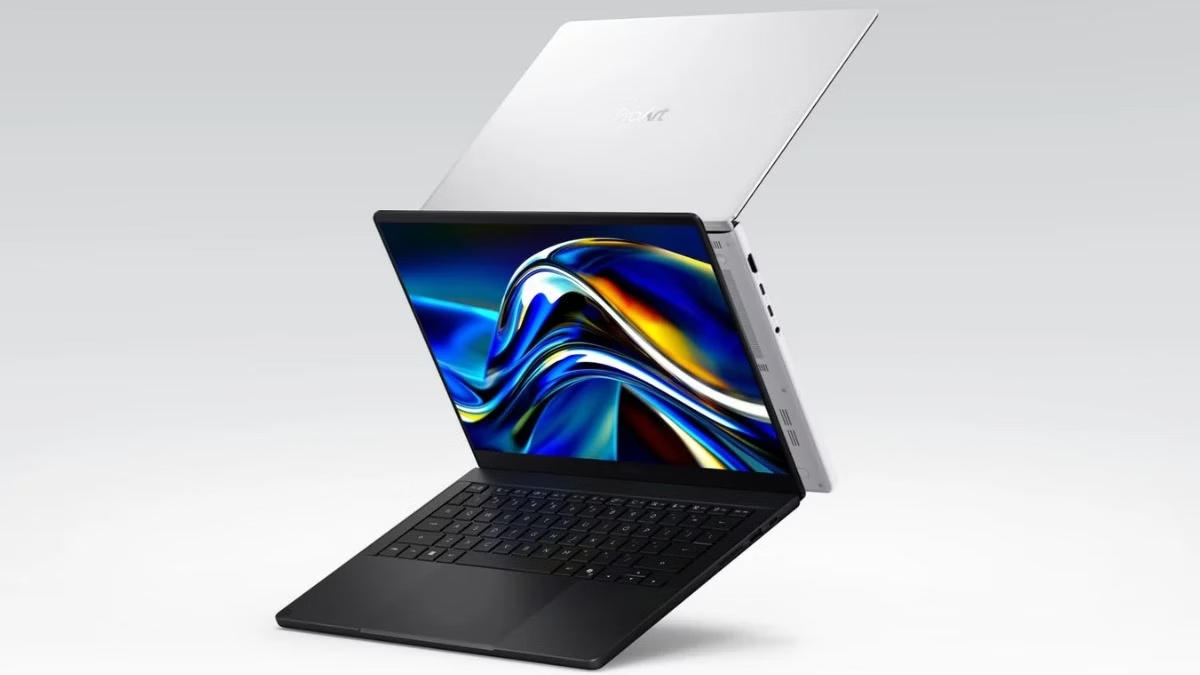
Asus has launched its new ProArt P16 and ProArt P14 laptops, bringing powerful on-device artificial intelligence capabilities to its creator-focused laptop lineup.
The two models were initially announced at Computex 2026 and are now being introduced with Nvidia’s new RTX Spark platform. The technology is designed to provide workstation-level computing capabilities for demanding AI and creative workloads without depending entirely on cloud processing.
The RTX Spark platform combines an Arm-based Grace CPU with a Blackwell RTX GPU. This architecture allows the system to handle intensive artificial intelligence tasks directly on the laptop while providing a shared memory environment for the processor and graphics hardware.
One of the platform’s most notable features is its unified memory capacity. Nvidia’s RTX Spark platform supports up to 128GB of unified memory, allowing the CPU and GPU to access the same pool of memory.
This architecture can be particularly useful for AI workloads that require large amounts of memory. Instead of separating system and graphics memory, the unified approach allows computing resources to work with the same available memory pool.
The Grace CPU can offer up to 20 processing cores, while the Blackwell GPU is equipped with as many as 6,144 CUDA cores. Together, these components are designed to deliver substantial computing performance for artificial intelligence and professional creative applications.
Asus says the RTX Spark platform can provide up to 1 petaflop of FP4 AI performance. The company also highlights its ability to run large language models containing up to 120 billion parameters locally.
The platform is further designed to support a context window of up to 1 million tokens. This capability could be useful for advanced AI applications involving large documents, extensive datasets and complex development workflows.
Running AI models locally can offer several advantages over relying exclusively on cloud-based processing. Users can potentially work with supported models without continuously sending their data to remote servers, while also reducing dependence on an internet connection for certain tasks.
The ProArt P16 and P14 are not focused exclusively on artificial intelligence. Asus is also targeting professional creators who need powerful hardware for demanding visual and multimedia applications.
The laptops are designed to handle workloads such as complex 3D rendering and 12K video editing. Generative AI applications are another major use case supported by the new hardware platform.
The combination of high memory capacity, a powerful CPU and Blackwell graphics architecture gives the new ProArt laptops a strong focus on professional computing. For creators and developers, this could make local AI processing more accessible without requiring a traditional desktop workstation.
The launch also reflects the broader shift toward AI-capable personal computers. As increasingly sophisticated AI models require more computing resources, manufacturers are developing systems capable of processing larger workloads directly on consumer and professional devices.
With the ProArt P16 and P14, Asus is bringing this approach to its creator-focused laptop range. The ability to run AI models with up to 120 billion parameters locally could make the new machines particularly relevant to developers, researchers, designers and content creators working with advanced AI tools.